From Understanding to Daily Practice: Building Tools for Personal Progress
From Understanding to Daily Practice
It has been a while since I posted here. Much has been happening behind the scenes, and I want to share where my attention is going.
I have had the inspiration to write several more books this week. With everything else I have been doing, the ideas are piling up in the queue. LOL. I now have 28 more titles in various stages of production.
You can follow that work in my Ambassadors Series Production Tracking spreadsheet.
For the moment, however, my priority is to build out the practical systems that help me put what I am learning to work. Two projects have become especially important in that effort: Life Manager and Corpus Librarian.
The question bringing them together is this:
How can growing understanding become a more functional daily life?
Life Manager: Supporting Follow-Through
Life Manager is a system I am developing to organize daily responsibilities, appointments, projects, observations, and personal progress.
It is moving beyond its initial framework into daily use. Recent records show completed routine entries and saved check-ins. Those are modest but meaningful steps: the system is beginning to help me record what I have done and see what still needs attention.
There is more work ahead. Routine actions need to be responsive, and the information needs to remain dependable. My next development priorities include measuring delays, making essential saves more efficient, and separating heavier analysis from the simple actions I need to take throughout the day.
The purpose is practical. I want less friction between an intention and its follow-through. I want useful information available when I need it. And I want the time invested in building the system to return value in the life it helps me live.
Corpus Librarian: Bringing My Research Within Reach
Over time, my writing, research, conversations, and reflections have grown into an extensive personal archive. Corpus Librarian is my effort to make that material searchable and connected enough to be useful.
Finding something I once understood can help me build on it. Seeing related passages together can reveal a question worth pursuing. Returning to the original source can also help me correct an interpretation rather than repeatedly building upon an uncertain recollection.
Recent development has added the ability to group captured searches into episodes and preserve associations with references back to the searches and source passages.
The latest overnight review processed seven topics and added five connections between them. Its recorded window contained no captured search episodes, however, so that run did not yet demonstrate learning from a day’s actual searches. Verifying that activity is captured, making supported associations useful in later searches, and measuring the results are still ahead.
I am encouraged by what is becoming possible. I also want the system’s usefulness to be demonstrated through experience. An interesting association is an invitation to investigate, and its sources need to remain available for examination.
Connecting Ideas About Growth
Alongside this technical work, I have continued developing my Ascension–Descension Governing Flow Dynamics diagram. It brings together patterns involving abilities, connection, alignment, moral regard, ownership and accountability, discernment, and wisdom.
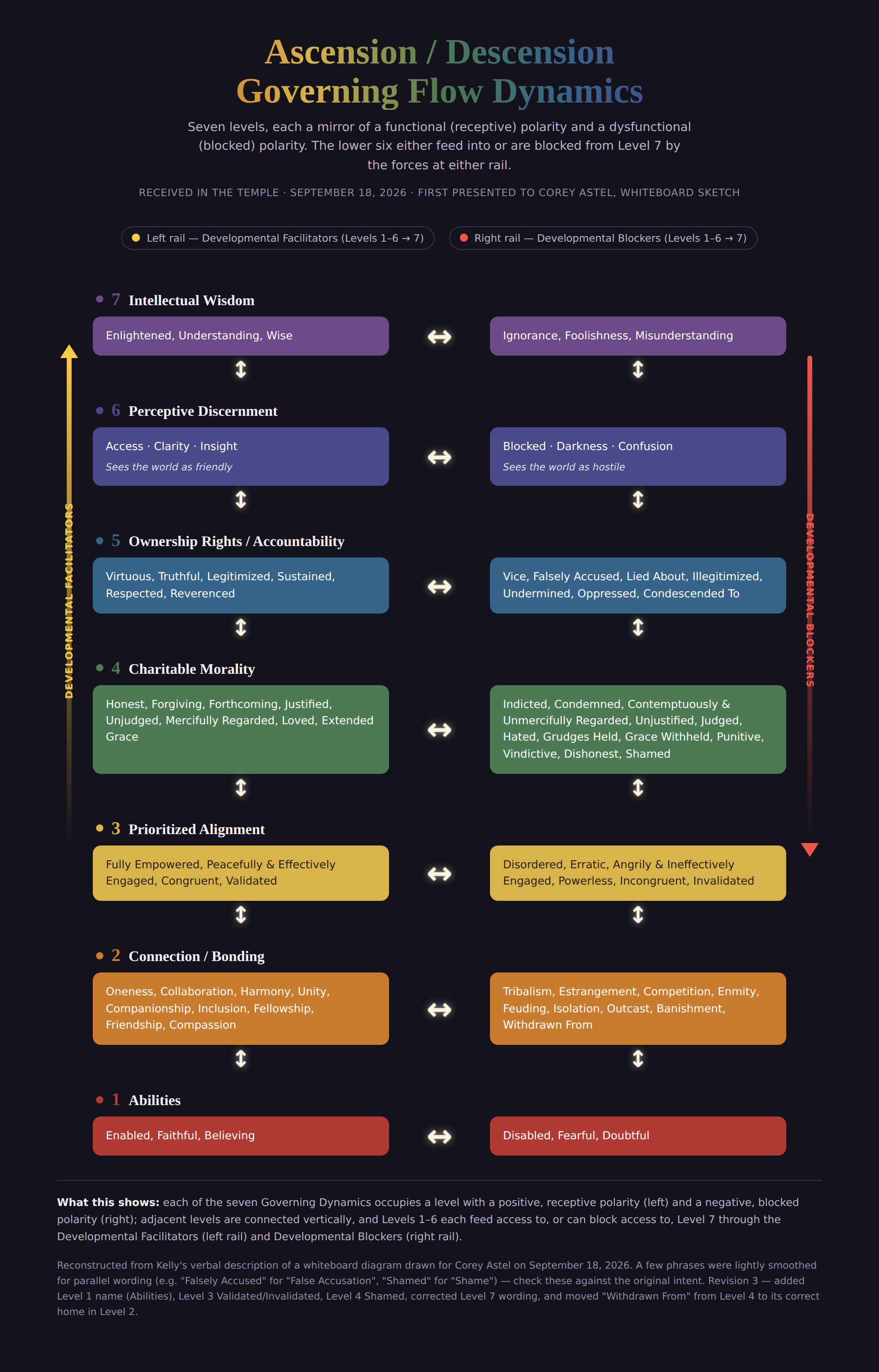
Ascension–Descension Governing Flow Dynamics — a developing conceptual map of how the Seven Governing Dynamics may support or obstruct one another.
The diagram helps me explore how these areas may interact as a system rather than merely as isolated qualities. It remains a developing conceptual model, open to clarification, correction, and further differentiation.
I have also been building a workbook called Semantic - Functional Differentiation of Corpus Terms. It helps me work through questions such as where a function originates among the Seven Governing Dynamics, how that same function may be expressed across the other Dynamics, and when similar-looking words actually describe different capacities or outcomes.
One of the distinctions I am exploring there is the difference between an ability and an applied “ibility” outcome. The workbook also maps terms vertically to their home or originating Dynamic and horizontally across their possible applications throughout the full system. That gives me a way to preserve functional distinctions without treating every cross-Dynamic application as if it changed a concept’s original home.
You can explore the workbook here: Semantic - Functional Differentiation of Corpus Terms.
Sharing this work with people I trust has been encouraging. Their responses have helped me see possibilities for clearer communication and practical application. That encouragement matters, and it strengthens my desire to keep learning carefully.
My Next Priority: Functional Sociability
Before writing more books right now, my priority is to build out Life Manager to include career development and wealth building as an aspect of functional Sociability.
Sociability concerns our field of connection and exchange. Career development brings that into everyday practice: developing useful capabilities, understanding where they can contribute, building relationships, and participating in worthwhile work.
Wealth building also belongs in this practical exploration. I want to develop a more deliberate approach to creating value, receiving fair compensation, managing resources, and strengthening the capacity to contribute over time. These are directions I intend to develop in the system, not features I am announcing as finished.
Respondability is relevant here too: the developed capacity to respond. An opportunity becomes more useful as the ability to meet it grows. Learning a skill, practicing it, organizing the next step, and receiving helpful correction all contribute to that development.
The work invites a more concrete question than simply asking what I hope to accomplish:
What capacities, relationships, and daily practices will help me participate meaningfully?
Keeping the Purpose in View
The books remain important to me. So do the tools. Their value grows as they help bring understanding into the ordinary decisions and relationships of life.
I want this work to support greater consistency, clarity, faith, and consideration for others. My study of Christlike Intelligence continues to shape that purpose: growing in ways that preserve agency, welcome correction, and make room for meaningful contribution.
There are 28 titles in the queue and plenty of ideas still arriving. For now, I am giving particular attention to the capacities and systems that can help sustain the work ahead.
That is the personal progress I am working toward: understanding that becomes increasingly useful in how I live, work, and contribute.
— Kelly L. Call